
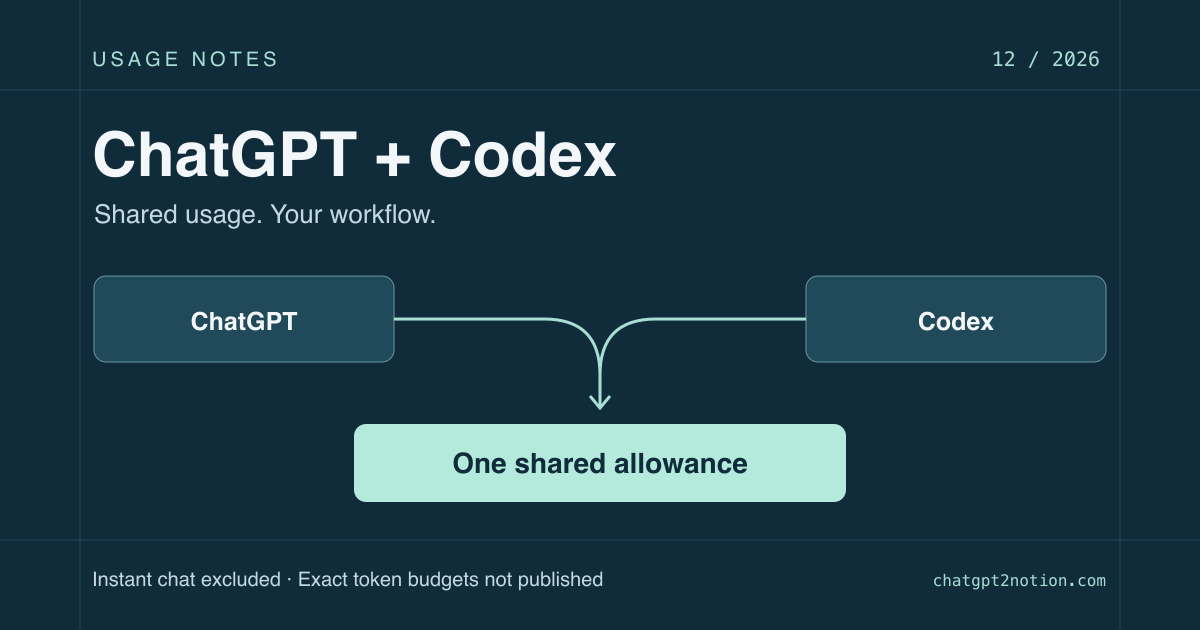
Checked November 3, 2026. OpenAI has announced a December transition to shared ChatGPT and Codex usage for Plus, Pro and Business. If you use both products, the useful question is how your combined workload fits the allowance—not how many messages an unofficial chart says you get.
Start here: Open the ChatGPT usage calculator to compare workflow considerations and estimate similar tasks from your own measurements.
What has OpenAI actually confirmed?
The official usage-limit announcement describes a shared allowance beginning in December for Plus, Pro and Business. It says consumption will be token-based, with the selected model and task affecting how much is used. Instant chat is excluded from this shared usage.
The same notice directs users to Settings → Usage for combined remaining allowance and reset information. It lists waiting for a reset, upgrading, or buying credits for eligible features as possible responses to a limit. Check which options your account actually offers.
What is still unknown?
As of our check, the transition notice does not provide:
- An exact day in December when every account will switch.
- A table of token budgets for each affected plan.
- A fixed consumption multiplier for each model.
- A reliable conversion from “one message” to allowance consumed.
These omissions matter. A calculator that inserts a guessed Plus token budget and a guessed Pro multiplier can produce precise-looking numbers without measuring your account at all. API token prices also cannot establish the size of a ChatGPT subscription allowance.
The notice names three plan families. Do not assume that it establishes identical transition rules for Free, Go, Enterprise or Edu.
Chat and Work merging is a separate rollout question
TechCrunch reported on November 2 that the combined interface would initially reach selected users for feedback. That is a report about interface availability, not an exact quota timetable.
Keep these two questions separate: whether your interface has changed, and which usage rules your account currently displays. A screenshot of a merged interface cannot tell you someone else’s token allowance. Community experiences can reveal usability problems, but they are not a rate card.
A short timeline to keep the dates straight
| Date | What it tells you | What it does not establish |
|---|---|---|
| November 2, 2026 | Media reported selected-user testing for the combined Chat/Work interface. | General availability for every account. |
| November 3, 2026 | We checked the linked official transition notice and prepared this guide. | That every account has already switched. |
| December 2026 | The official notice’s stated start month for shared ChatGPT/Codex usage. | A published December 1 deadline or exact per-plan token totals. |
How to estimate usage without inventing a token budget
Before you measure, open the allowance meter relevant to your work. If your account shows more than one usage window, keep each calculation within one window. Do not mix a weekly reading with a short-window reading, or a reading from before a reset with one after it.
- Note the remaining percentage immediately before a representative group of tasks.
- Run several similar tasks with the same model and settings. Avoid other simultaneous activity that could draw from the same meter.
- Note the percentage afterward and subtract it from the starting value.
- Divide that percentage-point drop by the number of completed tasks.
- Divide your current remaining percentage by the observed per-task cost.
Illustrative arithmetic, not an OpenAI benchmark: suppose three comparable tasks take a meter from 80% remaining to 74%. That is six percentage points in total, or two points per task. If you later have 50% remaining on the same meter, the linear estimate is roughly 25 similar tasks. Ten planned tasks would require roughly 20 points at that observed rate.
This does not promise 25 successful tasks. Rounded percentages, background activity, growing conversations and different task scope can change the result. A zero-point drop is too small to calibrate; measure a larger comparable sample rather than treating it as free usage.
The calculator performs that arithmetic locally in your browser. Its model/experience and task selectors explain the factors to consider; they do not apply hidden numerical multipliers. It does not sign into ChatGPT or retrieve your real allowance.
Which workflows deserve a closer check?
For mostly Instant chat, distinguish ordinary conversation from tools or other modes with separate rules. Exclusion from the shared allowance is narrower than a blanket promise of unlimited access.
For writing and research, sample the complete activity. An outline, a long draft, several file-based revisions and a final rewrite are different workloads. Keep a smaller baseline task to compare against a larger one, using observed readings for both.
For Codex work, measure a representative coding session rather than counting prompts. Repository context, retries and the scope of the requested change can make two requests very different. Re-measure after changing the model or task size.
For mixed ChatGPT and Codex use, record both activities once your account shows the combined meter. Measuring only chat while coding work continues in parallel can give a misleading estimate of what each task consumed.
A practical preparation checklist
- Check your account’s current meter and reset times before large work sessions.
- Keep a small record of model, task type, sample size and observed percentage-point drop.
- Re-measure when the account transitions, rather than carrying forward an old estimate as a new quota.
- Reduce unnecessary task scope and keep room for retries instead of planning to use the last percentage point.
- Save important completed work somewhere you can reference independently.
If you want a reference copy, our ChatGPT export options explain the available destinations, and AI Exporter Hub describes the combined extension. Saving a copy can make later reuse easier. It does not restore allowance, avoid limits, or imply that existing chats are scheduled for deletion. There is no backup deadline established by this usage announcement.
Frequently asked questions
When will ChatGPT and Codex share usage limits?
OpenAI’s transition announcement says December. As checked on November 3, 2026, it does not specify an exact day. It names Plus, Pro and Business.
Will Instant chat count toward shared usage?
OpenAI says Instant chat will not draw from shared usage. This does not establish unlimited access to all features and tools.
Can a calculator predict my exact ChatGPT token allowance?
Not from this announcement. It does not publish per-plan token totals or model conversion rates. Our calculator projects similar tasks from usage readings you supply.
Does exporting chats restore my allowance?
No. Exporting saves a reference copy. It does not replenish allowance or bypass usage limits. The transition announcement does not say existing chats will be deleted.
Sources and update scope
The OpenAI Help Center notice is the source for the transition rules; TechCrunch’s November 2 report supplies interface-rollout context. This guide is an editorial snapshot, not a live account dashboard. Check the source notice and your own Usage screen for later changes.